Tag Archive for feminist books

In Memoriam: Prof. Leela Dube (1923-2012)

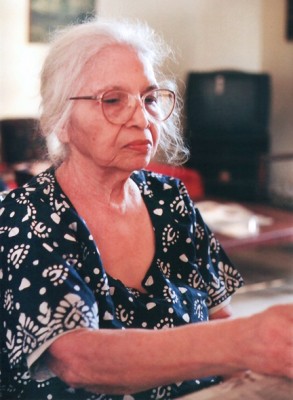
Leela Dube

Renowned anthropologist and feminist scholar Leela Dube passed away at her residence in Delhi on 20 th May. She was 89. Fondly called Leeladee, Prof. Dube was one of the pioneers of feminist scholarship in India

By Vibhuti Patel

With the passing away of Professor Leela Dube, we have lost a stalwart who broadened the discipline of anthropology by introducing the insights of women’s studies and enriched women’s studies as a discipline by bringing in the technical expertise of an anthropologist.

A well known figure in Indian Sociological Society in the 70s, Leeladee was responsible for introducing women’s studies concerns in mainstream sociology. She played a crucial role in the 1984 World Sociological Congress in which women activists and women’s studies scholars played a dominant role through the Research Committee Women in Society (RC 32). Leeladee chaired a panel on “Declining Sex Ratio in India”, in which Dr. Ilina Sen gave a historical overview of deficit of women in India throughout history of Census of India. Prof. Vina Mazumdar passionately spoke on the finding of towards Equality Report and I spoke on “Sex Selective Abortions-An Abuse of Scientific Techniques of Amniocentesis”.

Leeladee summed up the session with her insightful comments on the tradition of son preference in India. Her greatness lay in synthesizing complex concerns and providing an analytical framework in a lucid and convincing way. In a debate on sex selective abortions carried out in EPW during 1982-1986, her contribution was immense and her predictions about direct relationship of deficit of women and increased violence against women has proved to be true in the subsequent years.

Due to team efforts of women’s studies scholars like Prof. Leela Dube, RC 32 got institutionalized in World Sociological Congress. She invited many activists for the 12th International Congress of Anthropological and Ethnological Sciences, Zagreb, erstwhile Yugoslavia, in 1988 to present paper on “Codification of Customary Laws into Family Laws in Asia”. In the Congress, Leedadee’s speech on feminist anthropologist Eleanor Leacock provided new insights into departure of the feminist anthropologists from its colonial legacy of “Big brother watching you”. The power relations between the North and the South in construction of knowledge and the hegemonic presence of ETIC approach in academics were questioned by Leacock as well as Leeladee who propagated “dialogical approach” in anthropological and ethnographic research.

I respected her from a distance. I was too awe-struck to go close to her but always appreciated her sharp, witty comments during academic sessions and tea and lunch breaks at innumerable seminars, workshops and at Indian Association of Women’s Studies Conferences held every two years. She was appreciative of our campaign against sex selection. During 1981 and 1991, I got to listen to her speeches, deliberations and arguments as I used to be one of the rapporteurs in most of the programmes in women’s studies held in Mumbai and Delhi.

leela dube, Indian feminism, feminist scholars

Clockwise: Vina Mazumdar, Hanna Papanek, Gail Omvedt, Neera Desai and Leela Dube in Segovia, Spain, July 1990. Photo Courtesy: Vibhuti Patel

Each time I heard her, I got more motivated to read her papers and later on her books. Her work on Lakshadweep island’s matrilineal Muslim community- Matriliny and Islam: Religion and society in the Laccadives (1969)- was an eye-opener so was her deconstruction of polyandry in Himalayan tribes in the context of women’s workload of collection of fuel, fodder, water, looking after livestock and kitchen gardening in mountainous terrain, resulting into high maternal mortality and adverse sex ratio. She showed interconnections between factors responsible for social construction of women’s sexuality, fertility and labour, rooted in the political economy.

Her highly celebrated book Anthropological Explorations in Gender: Intersecting Fields (2001) is a landmark contribution in feminist anthropology in India. It examines gender, kinship and culture by sourcing a variety of distinct and unconventional materials such as folk tales, folk songs, proverbs, legends, myths to construct ethnographic profile of feminist thoughts. She provides a nuanced understanding on socialization of girl child in a patriarchal family, “seed and soil” theory propagated by Hindu scriptures and epics symbolizing domination-subordination power relationship between men and women.

Her meticulously researched piece On the Construction of Gender: Hindu Girls in Patrilineal India in the Economic and Political Weekly (1988), was used by women’s groups for study circles and training programmes. The volume Women, Work, and Family (1990) in the series on Women and Households, Structures and Strategies, co-edited by Leela Dube and Rajni Palriwala was extremely useful in teaching women’s studies in Economics, Sociology, Geography, Social Work and Governance courses. Her book, Women and Kinship: Comparative Perspectives on Gender in South and South-East Asia (1997) argued that kinship systems provide an important context in which gender relations are located in personal and public arena.

The co-edited volume Visibility and Power: Essays on Women in Society and Development by Leela Dube, Eleanor Leacock and Shirley Ardener (OUP 1986) provided international perspective on the anthropology of women in the context of socio-political setting of India, Iran, Malaysia, Brazil, and Yugoslavia.

After Prof. Iravati Karve, Prof. Leela Dube was the only scholar who made a path-breaking contribution in anthropology with gender sensitivity in India. Leeladee made a mammoth contribution in bringing academic credibility to women’s studies through her scholarly endeavours.

Vibhuti Patel is active in the women’s movement in India since 1972 and currently teaching at SNDT Women’s University, Mumbai.

Featured Photo by: Mukul Dube


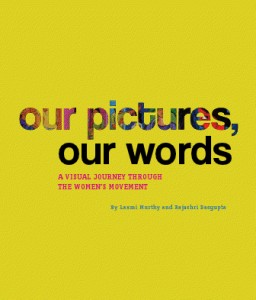
Our Pictures, Our Words: A visual journey through the women’s movement

Our Picture Our Words-

By Geeta Seshu

Our Pictures, Our Words by Laxmi Murthy and Rajashri Dasgupta, is a graphic history of protest, struggle, and solidarity in the women’s movement.

Around 25 years ago, a woman’s rights activist took my hand, more used to banging on a typewriter, and dipped it into a bucket of gum, playfully telling me, “now that you are an activist, you had better learn to stick a poster properly!”

The occasion was a demonstration in Mumbai’s Vile Parle against the sati incident in Deorala. As vividly as I still remember my first demo and Flavia Agnes – the feminist lawyer who started out by fighting her own battle against violence – showing me how to smear the gum on top of the poster so it would soak into the wall and remain there forever, I cannot for the life of me remember the poster I struggled to smear gum on.

The incident came back to me as I feasted on “Our Pictures, Our Words – A visual journey through the women’s movement’, with such a valuable collection of posters and photographs of so many years of struggle. Like Flavia’s simple act of instruction, it is a collection of memories and perspectives that can safely be handed over to a younger audience.

Zubaan’s poster project  – 1200 posters and still counting – is a vital record of the struggles and debates that marked more than a quarter century of the myriad issues and concerns of the contemporary women’s movement in India. There must be literally thousands of posters that just drifted away with the wind but at least we have these painstakingly preserved archives. And now, with this book by Laxmi Murthy and Rajashri Dasgupta, we also have the context in which the posters made their statements.

Billed as an educational tool, the book examines patriarchy and the violence of subordination. Divided into four sections, it looks at the politics of the body – of rape, domestic violence, sexual harassment; health and desire; at the domination of the community – of religion and personal laws, honour killing and religious extremism; at societal politics – the denial of political participation and citizenship and governance and lastly, at the politics of access to the environment and land and the ‘invisibilisation’ and exploitation of women’s labour.

A poster by Aalochana, Pune

To cram in all of this in an ‘educational’ book is a tall order indeed and the book seems to groan under the weight of all that text. Other books (A history of doing by Radha Kumar; The Issues At Stake: theory and practice in the contemporary women’s movement in India, Nandita Gandhi and Nandita Shah; Fields of protest, Raka Ray – to name just a few) have tried to grapple with the myriad issues raised by the women’s movement. To make the issues more accessible and comprehensible to a younger audience is a challenge indeed.

Taking the visual route is a wonderful way to do so. Throughout, the posters and pictures illustrate and bring to graphic life what may seem like a grim tale of the control and subordination of women and the violence and denial of women’s rights. What the posters and pictures do is provide a face to the anger. Look closely at the powerful “Indian Army Rape Us” picture of the ‘nude’ protest of the Meira Paibas in Manipur;  the brown and black poster of a woman breaking off her shackles (Shramjeevee Mahila Samity, Kolkata), or the scream of the woman strangled by religion (Sheba Chhachi and Jogi Panghaal for Saheli).

The visuals also do what the songs of the women’s movement did – uplift and celebrate the unity and solidarity of women, their strength and spirit. So even as Laxmi Murthy and Rajashri Dasgupta examine the posters and how they depict the issue at hand (for example, the opening passage in the section on domestic violence is a gentle reminder that the early years of the women’s movement emphasized the ‘victim’ status of the woman with depictions of the drops of tears and blood and the downcast look ), they also pick up posters that celebrate – from the earlier posters of women streaming out of factories and fields to the later posters on sexuality and diversity.

The book does, alas too briefly, examine the image itself. Why were the women drawn in the way they were – ‘as sari-clad, long-haired, buxom and fair’ women  and as dark-skinned, barefoot rural counterparts? Why were such few ‘urban’ women depicted in the posters – the short-haired women who were the bane of Janata Dal leader Sharad Yadav? How did posters from the NGOs with their development agendas depict women and women’s issues?

It also does not discuss the manner in which these posters came to life, the discussions and ideas of women’s groups or individual artists and illustrators who were roped in, often making posters even as the protest was underway, cutting out or retaining something and even the ownership or copyright issues that have cropped up with some posters or the fact that in so many of the posters, ‘ownership’ simply didn’t matter. That does tell you another tale of the women’s movement and one hopes another edition will redress these gaps.

Geeta Seshu is a Mumbai-based independent journalist who obsesses about media representation of women, freedom of expression, media literacy, the women’s movement and all else besides!